Pope urges humanity to build a civilization of love in the digital world
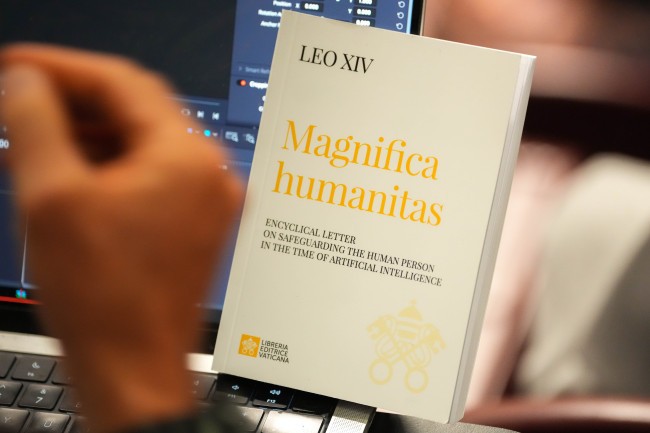
VATICAN CITY (CNS) -- At a time when digital technologies are developing at a rapid and unpredictable pace, every single person must decide if she or he will be: a passive bystander; an unhelpful commentator; an avaricious architect of a new "Tower of Babel"; or a patient, hope-filled builder of a "civilization of love," Pope Leo XIV said in his first encyclical, "Magnifica Humanitas."
In the 82-page document, released May 25, the day after Pentecost, the pope also asked forgiveness for the Church's long tolerance of slavery, and he declared that its "just war theory" was now outdated.
"Today, more than ever, without prejudice to the right to self-defense in the strictest sense, it is important to reaffirm that the 'just war' theory, which has all too often been used to justify any kind of war, is now outdated," he wrote.
"Humanity possesses far more effective and capable tools for promoting human life and resolving conflicts, such as dialogue, diplomacy and forgiveness. The use of force, violence and weapons reflects a relational poverty that always has disastrous consequences for civilian populations," the pope's new document said.
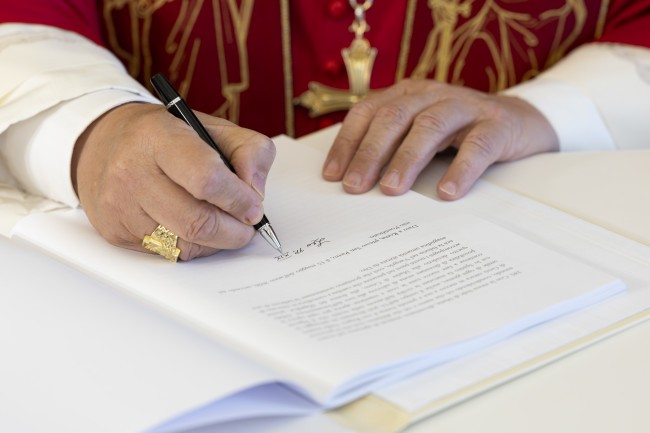
The document, signed May 15, marked the 135th anniversary of his namesake's landmark social encyclical, "Rerum Novarum," which reflected on society, the economy and politics, and ushered in what is now known as the "Social Doctrine of the Church."
"When some objected that the Church should not waste energy on worldly matters, but instead focus on communicating the message of eternal life, Leo XIII responded with realism and wisdom, saying that the proclamation of the Gospel cannot overlook the concrete lives of people," Pope Leo XIV wrote.
While his turn-of-the-last-century predecessor focused on the industrial revolution's impact on the human being and society, Pope Leo looked at the consequences of the digital revolution in the 21st-century and how best to safeguard "the human person in the time of artificial intelligence."
Pope Leo used nearly the first half of the document to outline the role and development of the church's social teaching, and why and how it continues to be needed in a world facing both old and new challenges.
"Today, the Social Doctrine of the Church is a legacy of wisdom, where we find principles for thought, criteria for discernment and judgment, and concrete guidelines for action" to "clearly interpret the challenges of the present and identify appropriate ways for living out a clear Christian witness, with joy and in service to the world," he wrote.
"It is not an inert set of concepts, but a living corpus of truth that safeguards and interprets humanity's vocation to a full and just life. I therefore wish to add my own voice to this living tradition," he added.
Listening to and engaging with the wider world, especially those active in the fields of science, technology, academia and politics, he wrote, is crucial to a process of "shared discernment" to identify and heal the spiritual and cultural roots of present-day problems rather than issuing reactive pronouncements or "risk letting the succession of emergencies dictate the direction of our path."
While the Church is concerned with theological, "anthropological" and social questions, it is also "necessary to establish adequate regulatory tools capable of upholding justice and curbing the distorting effects of technological power," the pope wrote.
"Nevertheless, the issue is not limited to regulation. As Pope Francis warned, we must realistically ask ourselves who holds this power today and how they use it," he added.
"Humanity, created by God in all its grandeur, is today facing a pivotal choice: either to construct a new Tower of Babel or to build the city in which God and humanity dwell together," he wrote. Every generation has the same duty of "guiding history to become a place where the dignity of every person is safeguarded, justice is promoted and fraternity is made possible."
While the document was embedded "in a time of artificial intelligence," it also included a wide gamut of ongoing, lingering ills such as: the exploitation of people and nature; war; the arms race; disrespect for human life; threats to democracy and the common good; discrimination against the poor and women; and new forms of slavery.
"Human trafficking must be recognized as a contemporary form of slavery and a grave violation of human dignity. Failing to respond firmly, or tolerating these practices in any way, is in some way to become complicit in today's sins, which are akin to those of the past when slavery was being concealed and justified," Pope Leo wrote.
While the Catholic Church constantly affirmed the dignity of every human being, he wrote, "neither can we deny or diminish the delay with which both society and the Church came to denounce the scourge of slavery," noting it wasn't until the 19th century "that a formal, absolute and universal condemnation of slavery was clearly articulated, notably under Pope Leo XIII."
"This development offers a clear example of the Church's growth in understanding the perennial truths of Revelation that she safeguards," he wrote, "even if it took eighteen centuries for its full incompatibility with slavery to be explicitly recognized."
"This constitutes a wound in Christian memory, one from which we cannot consider ourselves detached," he wrote, and "for this, in the name of the Church, I sincerely ask for pardon."
It is "a shared responsibility," he wrote, of all members of the human family to come together and discern "Where are we going? Toward what goal do we wish to orient ourselves? What direction should we choose as a people and as a human community?"
"The search for the truth in public life, education in the digital environment, the transformation of work, the fragility of families and new forms of slavery are not isolated phenomena," he wrote. "Rather, they reflect a common underlying issue, namely that if technology becomes the ultimate criterion, the human person risks being reduced to data, a cog in a machine or a commodity."
"If, however, technology is integrated with a wise perspective, it can become an instrument of growth, justice and fraternity," he added.
Innovation can genuinely serve integral human development and integral ecology, Pope Leo wrote, "rather than becoming a source of exclusion and dominance."
Referring often to St. Augustine's teachings, Pope Leo clearly defined the two "cities" people today must choose to contribute to: either a worldly, selfish land dedicated to building a "Tower of Babel" or a Christian "civilization of love in the digital age."
He decried today's "culture of power" that was "normalizing" war, ballooning military arsenals, and fomenting fear and polarization; he reinforced the Vatican's long-standing opposition to leaving the decision to use lethal force to AI or "to opaque or automated processes."
The pope also condemned today's "false realism," calling it "truly irresponsible" to stoke resignation by pretending war is inevitable and peace and dialogue are "utopian or irrational positions that ignore the risks at stake."
"In fact, peace is neither a naïve hope nor merely the absence of war; instead, it is always possible as the fruit of justice and charity," he wrote.
Pope Leo underlined the need for everyone to take responsibility in building a better world by quoting the wizard Gandalf in J.R.R. Tolkien's "The Lord of the Rings. The Return of the King." "It is not our part to master all the tides of the world, but to do what is in us for the succour of those years wherein we are set, uprooting the evil in the fields that we know, so that those who live after may have clean earth to till."
Pope Leo then proposed five paths toward daily and public responsibility: "the need to disarm words; building peace through justice; adopting the perspective of victims; cultivating a healthy realism; and reviving dialogue and multilateralism."
Fundamentally, he added, what is needed is the Christian view of humanity and understanding of God's plan for his creation.
"As a believer among believers, I invite everyone to contemplate, in the face of the Son of God, the grandeur of humanity that shines a light also on the era of AI," he wrote. "In Christ, we are called to cooperate in the work of creation, rather than be disinterested observers of technological processes that limit our freedom and responsibility."
"The dignity inscribed in each of us by the Holy Spirit can also be seen in our capacity to reflect critically, choose and love freely, and form authentic relationships," Pope Leo wrote.
"No computational system, however sophisticated, can create a heart that gives itself, or a conscience that discerns good from evil," he wrote. "Even when machines excel in efficiency, a human face that asks to be gazed upon remains the center of our history."